


Researching dental implants and getting bogged down by terminology like “titanium,” “zirconia,” and “All-on-4”? You’re not by yourself. When all you want to do is understand your options for replacing lost teeth, the language might be intimidating.
At Sunrise Mall Dental, we understand that missing teeth affect more than just your smile. It affects bone health, nutrition, and digestion—all of which are particularly important for elderly people. The good news? The best option for replacing lost teeth is dental implants, and you may probably find a solution that works for you and your budget.
The varieties of dental implants, their cost, and why age shouldn’t be a barrier are all explained in this clear and concise overview.
The Main Types of Dental Implants
Endosteal Implants (The Standard Choice)
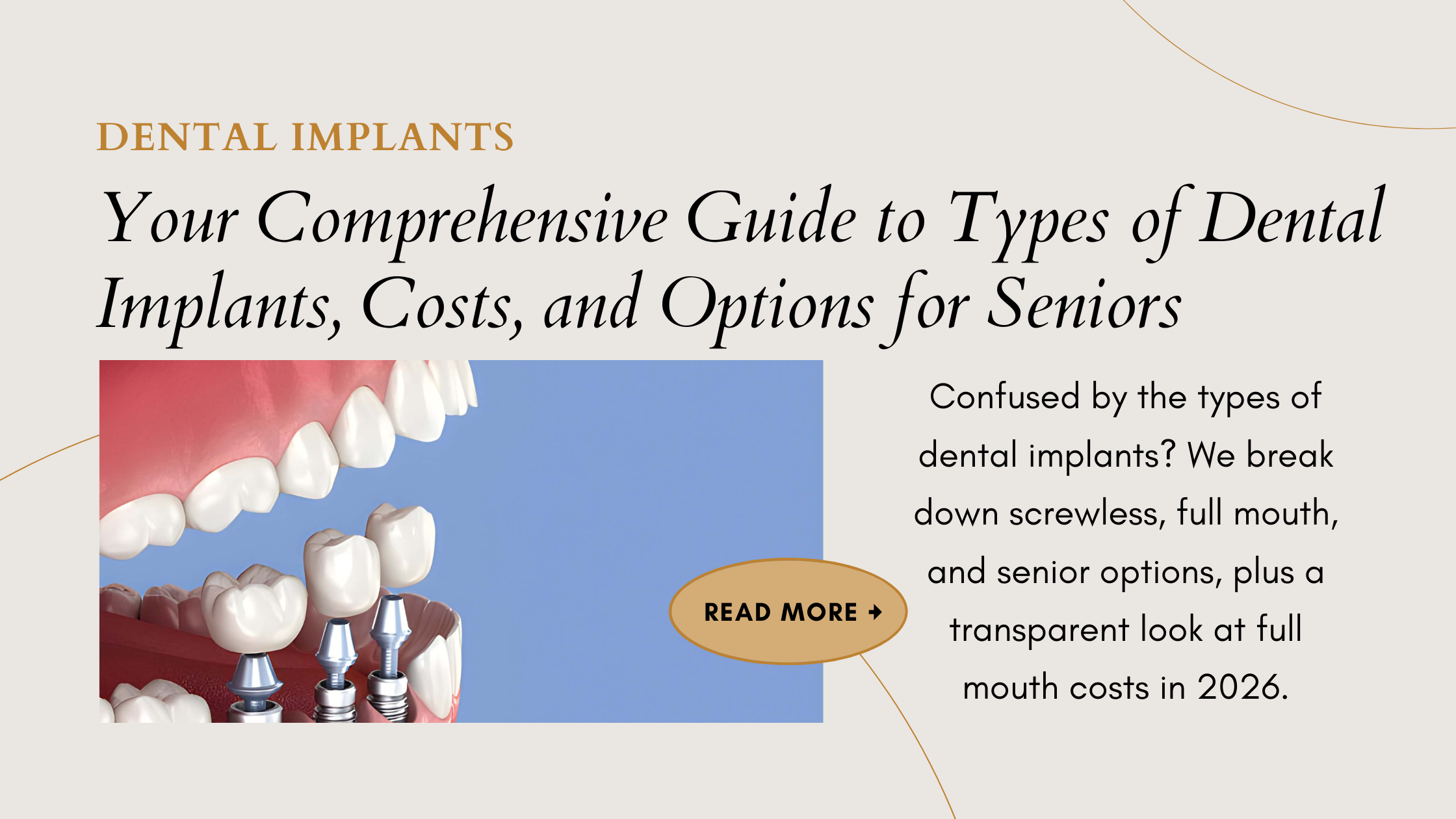
When most people think of dental implants, they image these titanium screws that are inserted straight into your jawbone. A crown is affixed to the implant once it has fused with your bone over several months.
Best for: Individuals with strong mandibles. They are the most dependable choice because their success rates are more than 95%.
Subperiosteal Implants (The Alternative)
These employ a metal frame that rests on top of the jawbone but behind the gums rather than drilling into bone. Artificial teeth are held in place by posts that pierce the gums.
Best for: Individuals with substantial bone loss who desire greater stability than dentures but are unable or unable to undergo bone grafting procedures.
Zygomatic Implants (The Specialist Solution)
These extra-long (up to 50mm) implants completely circumvent the upper jaw by anchoring into your cheekbone instead of your jawbone.
Best for: Severe bone loss in the upper jaw. They require a highly skilled surgeon, although they do not require substantial bone grafting.
Specialized and Innovative Options
Screwless Dental Implants
When consumers look for screwless dental implants, they are either interested in mechanics or appearance:
- Cement-retained crowns: For a more natural appearance, the crown is securely bonded to the implant connection, removing the apparent screw access hole.
- Systems for locking taper: To potentially reduce bacterial leakage, use friction rather than screws to hold components together.
Best for: Patients who desire fewer possible bacterial traps or front teeth where aesthetics are crucial.
Immediate Load Implants (Same-Day Teeth)
Instead of waiting months for your implant to cure, get a temporary tooth the same day it is placed.
Requirements: adequate initial implant stability and good bone quality. Although not everyone is eligible, it can change the lives of those who are.
Mini Dental Implants
These implants need less invasive surgery and have a diameter that is roughly half that of normal implants.
Best for:Seniors with modest bone loss or anyone wishing to fix loose dentures without significant surgery at a reasonable cost.
Full Mouth Dental Implants: Complete Restoration
The All-on-4 and All-on-6 Revolution
Full mouth dental implants use just 4 or 6 carefully positioned implants to support an entire arch of teeth, as opposed to replacing each tooth separately (requiring 12–14 implants).
Pros:
- Significantly less expensive than individual implants
- frequently stays away from bone grafting
- Reduced surgical sites and quicker healing
- On the same day, many patients receive temporary teeth.
Cons:
- The bridge as a whole could be jeopardized if one implant fails.
- requires thorough cleaning beneath the prosthesis.
Removable vs. Fixed Full Mouth Options
Implant-Supported Overdentures (Removable):
- Snap onto two to six implants
- taken out every day for cleaning
- $10,000 to $15,000 each arch is more reasonably priced.
- Simpler upkeep for people with dexterity problems
Fixed All-on-4/6 Bridges:
- Permanently attached; only removable by your dentist
- they feel most like real teeth.
- Costing between $20,000 and $30,000 each arch,
- need to practice good dental hygiene below
Dental Implants for Seniors: You’re Not Too Old
Myth: “I’m too old for implants.”
The Reality: there is no age restriction. Age is not a factor in success; rather, health and bone health are. Patients with implants continue to have good results well into their 80s and 90s.
Special Considerations for Older Adults
Bone Density: Seniors frequently have osteoporosis, but this does not rule you out. You might require micro implants or bone grafts. Your doctor and dentist must work together to coordinate some osteoporosis drugs.
Time for Healing: Diabetes and other illnesses can prolong healing times, and seniors heal more slowly. Plans for treatment might be modified as necessary.
Benefits to Quality of Life: Unlike dentures, implants don’t slip, maintain facial bone structure, improve confidence, and restore proper chewing for improved nutrition.
Maintenance Matters: Removable implant-supported dentures are frequently simpler to maintain than permanent bridges for elderly people with arthritis or diminished dexterity.
Dental Implants Cost Breakdown
Location, materials, and your particular requirements all have a big impact on costs.
The average cost of a single tooth implant is between $3,000 to $4,500, which usually includes the crown, abutment, and implant.
Additional costs that may apply:
- Tooth extraction: $150-$400
- Bone grafting: $250-$1,100
- Sinus lift: $1,500–$2,500
- CT scan: $200–$500;
Full Mouth Dental Implants Cost
Cost of Full Mouth Dental Implants Removable overdentures: $10,000–$15,000 each arch (most economical)
Fixed All-on-4/6 bridges: mid-range, $20,000–$30,000 per arch
$40,000–$60,000+ per arch for individual implants per tooth (rarely done)
What Influences Cost?
Materials: Titanium is the most common and reasonably priced. Zirconia provides a metal-free alternative at a cost of 10–20% higher.
Preliminary procedures:The sum is increased by extractions, grafts, and gum treatments.
Geography: Compared to rural areas, urban hubs are substantially more expensive.
Provider experience: Specialists may have better results for complicated conditions, but they charge more.
Financing Options
- Parts of implant costs are increasingly covered by dental insurance.
- Implants resulting from trauma or illnesses may be covered by medical insurance.
- Payment plans are provided by CareCredit and comparable lenders.
- Dental schools provide treatment by supervised residents at a lower cost.
Making Your Decision
Select the appropriate dental implant kinds based on:
- Your medical requirements: Bone quality and the requirement for initial treatments are revealed via a 3D scan.
- Functional specifications: While back teeth require strength, front teeth favor appearance.
- Health status: Seniors with long-term ailments should pay particular attention to dental implants.
- Budget: Look at starting with less expensive solutions or phased treatment.
- Maintenance ability: Tell the truth regarding your ability to take care of your implants every day.
Take the Next Step with Sunrise Mall Dental
There is a solution tailored to your particular circumstance, ranging from full mouth dental implants for total restoration to screwless dental implants for improved aesthetics. Dental implants for seniors have been shown to improve quality of life, therefore age is not a barrier.
Don’t allow uncertainty or financial worries to deter you. Make an appointment with Sunrise Mall Dental to obtain:
-
A comprehensive assessment of your particular circumstances
-
A customized course of treatment
-
A precise cost estimate
-
Answers to every query you may have
The majority of firms provide free or inexpensive consultations with no commitment to move forward. Your rejuvenated confidence, better health, and restored smile make that initial chat worthwhile.
Are you prepared to consider your options? Find out which kinds of dental implants are ideal for you by getting in touch with us right now.
For more dental related services you can visit my website – https://sunrisemalldental.com/general/
